• Work
  • About
  • Resume

Made with lots of
dirty matchas and <3love

Taylor Torres ~ © 2026

Say hi!! ⸜(。˃ ᵕ ˂ )⸝♡

  • Email ↗
  • LinkedIn ↗ (opens in a new tab)
Home
  • ˖ ִֶָ🌚 Overview
  • Solution Preview
  • Reflection
  • Reach Out!
Home
  • ˖ ִֶָ🌚 Overview
  • Solution Preview
  • Reflection
  • Reach Out!
  • Internship
  • Systems Design
  • Data Synthesis

Bringing Stories to Life with Props, at Scale

The Duolingo wordmark in white on bright green, with Duo the owl peeking up from the bottom edge
Role
Product Design Intern
Timeline
August - September2026 (4 weeks)
Team
1 Product Manager2 Software Engineers1 Designer (me!)1 Studio Manager
Skills
Systems DesignData SynthesisProduct Strategy

Impact

  • 1,000+

    Stories audited

  • 134

    Props categorized

  • 12+

    Edge cases designed for

Overview

Building a scalable system for 1,000+ stories

Over the summer I joined the Reading & Writing team to work on an unreleased, more visual version of Duolingo Stories.

My task was to explore ways to add “props” to these stories, bridging the gap between what learners read and what they see on screen. The catch was that every scene needed to be assembled automatically, so bespoke designs were out of the question. Whatever I designed had to work across thousands of scenes without any human oversight.

So I built a rules-based system. Collecting data on how often props appeared and in what forms, I sorted every prop into a small set of categories, designed specialized treatments for the most common ones, and worked through the edge cases that could break it. I documented the full system and presented it in a cross-functional handoff with engineering, PM, design studio, and design managers, giving the team a strong foundation to build off during implementation.

Process & Solution Preview

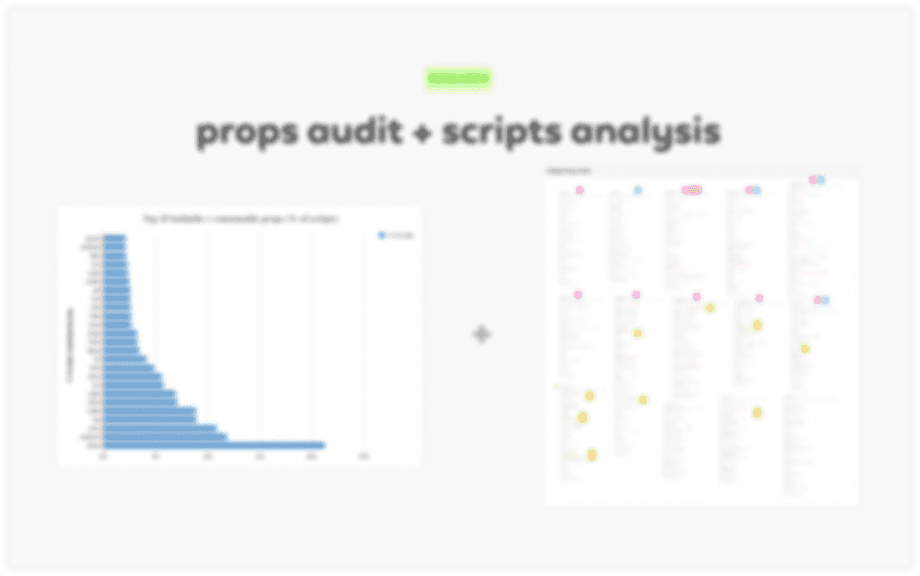
Blurred preview of the props audit and script analysis: a bar chart of how often props appear beside a grid of tagged scripts

Synthesizing messy script data

I distilled 1,000+ stories and 134 props into one clear definition and scope, so the team knew exactly what to design for
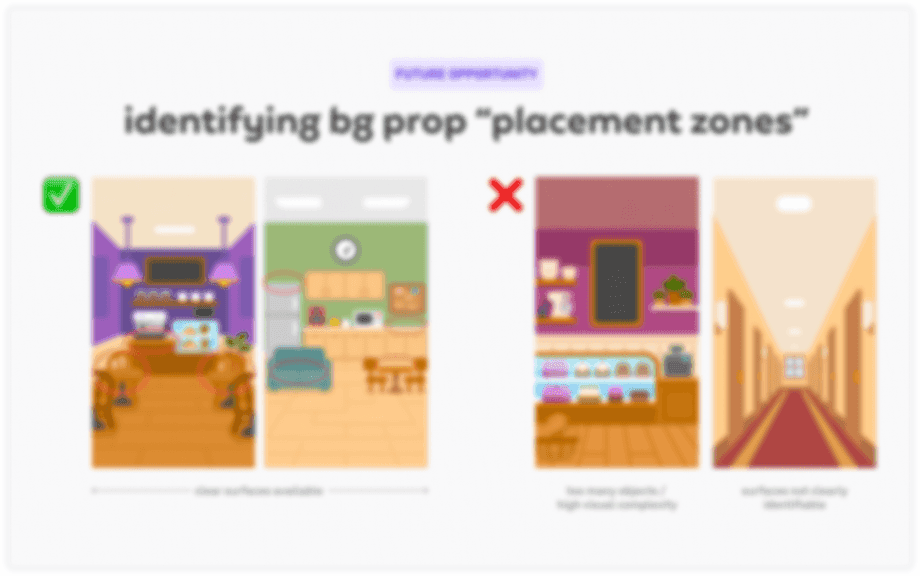
Blurred preview of background prop placement zones: two story scenes with clear surfaces marked as good, and two cluttered scenes marked as not

Defining a framework that works for any prop

I created one set of rules that decides how every prop appears, replacing one-off designs with a single comprehensive system
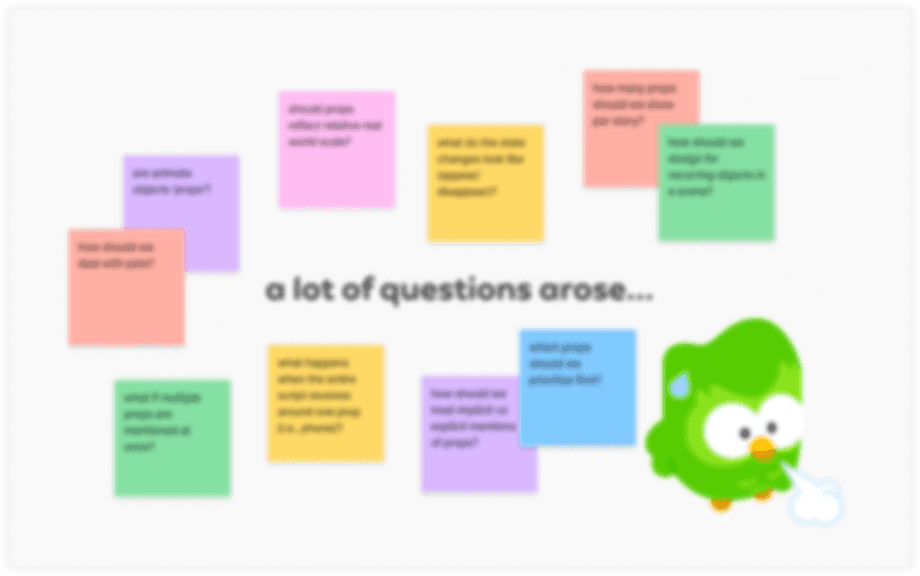
Blurred preview of edge case sticky notes around the words “a lot of questions arose…”, with a worried Duo

Stress-testing the system with (a lot of) edge cases

I identified various edge cases and designed specialized treatments and low-lift fallbacks, so the system always had a default

Reflection

Learning to bend without breaking

Early on, my PM called this project “an edge case goldmine,” and he wasn’t kidding (ᵕˆヮˆ).

Just when I thought I had the framework figured out, another script would come along and break it. I kept coming back to one of the first questions I asked, which seemed deceptively simple: what even counts as a prop?

I expected a project this rules-heavy to feel restrictive, but it ended up being one of the most creative things I worked on all summer! My favorite part was determining which rules to hold on to and which ones to stretch.

Reach Out!

🔒This case study is under NDA

Due to the nature of this project, the specific designs I worked on are private, but I'm happy to chat about and walk through my process in more detail over a call.

📧 Reach out to me at tjulest@stanford.edu

Next up

Treeats: Rebuilding student trust in campus dining info

Demystified dining by crowdsourcing live reports and rewarding top contributors.

Read next→